
tradinect one
Our Philosophy

Connecting Japanese Traditions
to the World and the Future

tradinect one is a name made by joining two words: tradition and connect. We are not a company that merely sells traditional crafts. We want to carry everything standing behind the work — the artisan's life, their values, the history and the culture — out to the world and on into the future.

The Problem We Face
What people don't know
never gets chosen.

Japan holds crafts the world would admire. And yet, workshop after workshop is quietly closing. No successor. An artisan growing older. Price competition with cheap mass production. And above all, fewer and fewer people who know the craft exists at all.

What isn't known isn't supported. What isn't supported doesn't continue. What doesn't continue is lost.

So we began with the simplest thing: making the work known. Not selling it, not protecting it, but creating the encounter. That is where we stand.

By the Numbers
In forty years, the industry shrank to a fifth of its size.
Production value
In hundred-million yen. The FY1983 peak against the most recent year, FY2022.
5,400 1,050 1983 2022 -80.6%
People working in the industry
Number of people. The FY1979 peak against the most recent year, FY2022.
288,000 48,334 1979 2022 -83.2%
Age of the workforce
People in their fifties and above make up 63.6%; those in their twenties or younger, 6%. METI has noted the workforce could halve within ten years.
6%
30.4%
45.6%
18%
Under 30 — 6% 30s–40s — 30.4% 50s–60s — 45.6% 70s and over — 18%

Sources: production value and workforce figures are estimates by the Association for the Promotion of Traditional Craft Industries (production value: FY1983 and FY2022; workforce: FY1979 and FY2022). Age composition is from materials published by METI's Traditional Craft Industries Office. The 30–40s share is derived as the remainder of the published figures.

Who We Are

One day, my grandmother put down her needle.
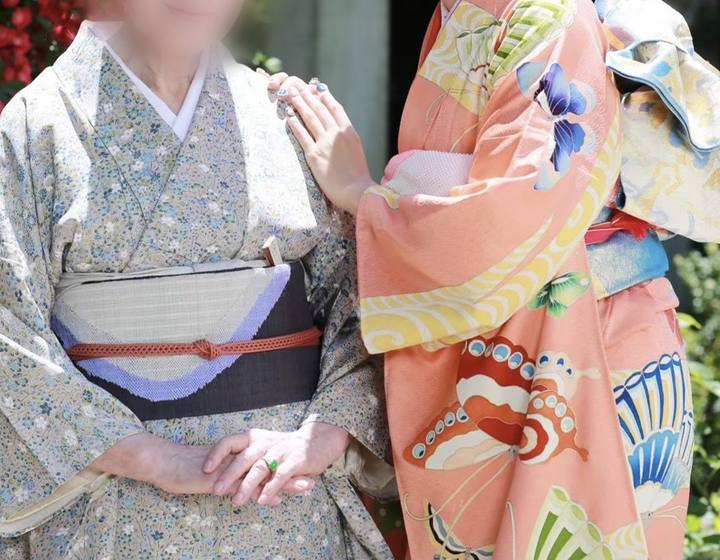
My grandmother tailored kimono; my mother practises the tea ceremony. Tradition was something that lived inside our family.

My grandmother made her living tailoring kimono. She had done it for a very long time, and then one day, because of her age, she put down the needle. My mother still practises the tea ceremony. But the number of people gathering in her school grows smaller every year.

When a tradition is lost, nothing dramatic happens. One person stops working. The circle thins by one, then another. That is all. Unless someone moves, it simply comes quietly to an end. Having watched that from right beside my own family, I felt that I had to be the one to move.

tradinect one is a small business run by the two of us, based in Motobu in the north of Okinawa's main island. Being small lets us meet every artisan face to face and work at the pace that suits them.

We did not come to the workshops as people with something to teach; we started as the ones being taught. What moved us was never the technique itself, but the way of living of the person who had kept choosing it. That is why the maker is always introduced alongside the work.

Kano Nakano — Representative, tradinect one Motobu, Kunigami, Okinawa
Mission · Vision · Value
The MVV of tradinect one
Mission
Connect traditional crafts to the future.
We say connect rather than preserve. Culture is not something to be stored; it is something handed from one person to the next.
Vision
A society where being an artisan remains a career you can actually choose.
So that a young person can realistically take this path, income and recognition have to reach the artisan. We build the structures that make that possible.
Value
Not objects, but stories.
Who made it, with what intent, and how. Handing over that story is the very centre of our work.
Not support. An encounter.

A single piece of cloth, or a single day in a workshop. Both lead to the same place.